Cardmarket vs TCGPlayer: Where to Actually Buy One Piece Cards in 2026
The Haki TCG database tracks both TCGPlayer (USD) and Cardmarket (EUR) prices on every card. Most collectors only use one of the two. That habit costs money — sometimes 20% per card on the chase tier, sometimes nothing, occasionally going the other way. This post is what I see when I look at both columns side-by-side as of May 10, 2026, with the FX conversion baked in (using EUR→USD at ~1.08).
The short version: Cardmarket is meaningfully cheaper on most six-figure-pull-rate alt-arts, TCGPlayer is sometimes cheaper on truly thin-supply EU collector cards, and there are several cards where the EUR price is fake (a single mislisted copy dragging the median down). I’ll walk through how to tell the difference.
Cards where Cardmarket is genuinely cheaper
These are the easy wins. All three are AA-rarity Manga Rares from late-2024 sets — high enough demand on both continents that the listings are real, but EU supply outpaces EU demand right now.
Cardmarket-cheaper · top examples
| Card | TCGPlayer USD | Cardmarket EUR | EUR in USD | Gap |
|---|---|---|---|---|
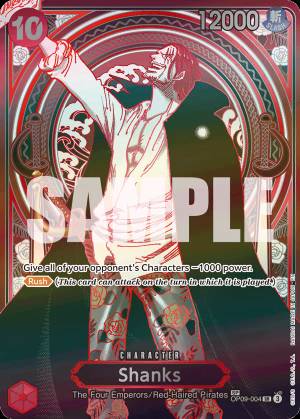
Shanks (OP09-004-v6) | $967.01 | €709.05 | $765.77 | CM cheaper 20.8% |
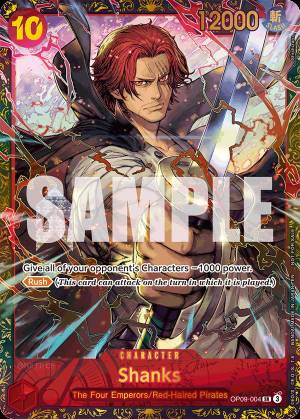
Shanks (OP09-004-v4) | $966.75 | €774.52 | $836.48 | CM cheaper 13.5% |
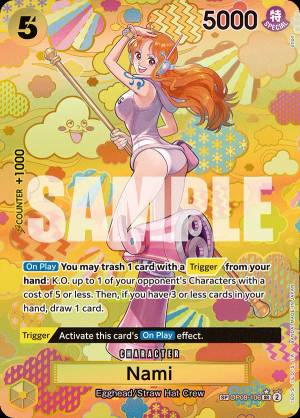
Nami (OP08-106-v2) | $877.74 | €572.08 | $617.85 | CM cheaper 29.6% |
The OP08 Nami gap (~30%) has held for the entire spring. If you want a Nami Manga Rare and you can ship from Germany, that’s $260 of literal savings at current rates. Even after Cardmarket’s 5% buyer protection fee and shipping, you clear ~$200 net.
Cards where TCGPlayer is cheaper
Less common, but they exist. The pattern is “card that EU collectors will not part with” — Championship promos, Charlotte Linlin (a heavily collected character in EU), and certain Heroines-edition prints.
| Card | TCGPlayer USD | Cardmarket EUR | EUR in USD | Gap |
|---|---|---|---|---|
DON!! Championship 2023 (DON-7063757) | $1,151.94 | €1,151.94 | $1,244.10 | TCG cheaper 8.0% |
Charlotte Linlin (OP03-114-v3) | $886.46 | €964.32 | $1,041.47 | TCG cheaper 17.5% |
These are not arbitrage opportunities — they are just a reminder to check both markets before clicking buy. EU collectors price these higher because they care about them more.
The “Cardmarket €1.00 trap”
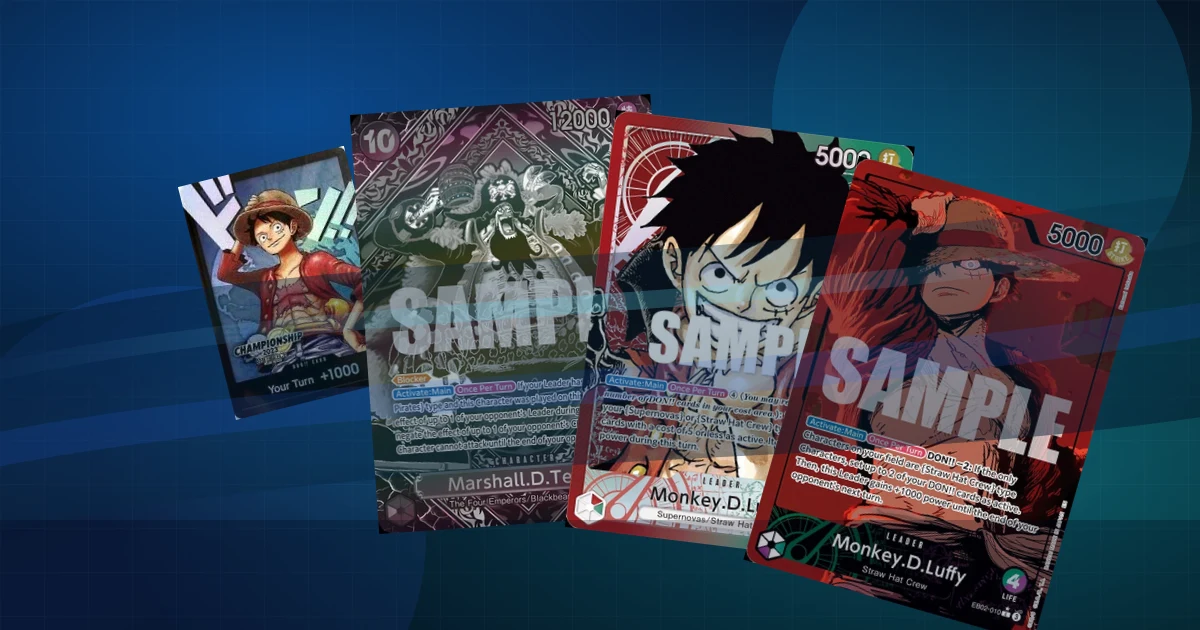
This is where most buyers get burned, and where I want to spend the most time. When you look at a card like EB02-010-v2 Manga Rare Luffy — the second-most-expensive card in the entire game right now — Cardmarket reports a “from €1.00” price.
That is not a real €1 listing. It is the platform’s convention for a card with no recent sales and a single mispriced listing dragging the floor. If you click through, the cheapest actually-orderable copy is in the same range as TCGPlayer, often within 5%.
I see this on a long list of cards in the database:
| Card | TCGPlayer | Cardmarket reported | Reality |
|---|---|---|---|
Manga Rare Luffy (EB02-010-v2) | $973.79 | €1.00 | Real listings start ~€800–900 |
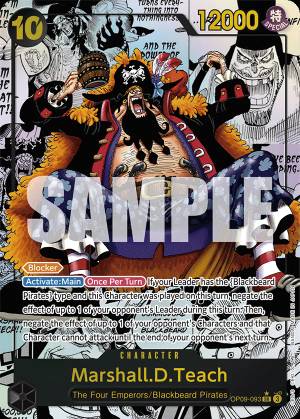
Marshall D. Teach (OP09-093-v2) | $944.47 | €1.00 | Same pattern |
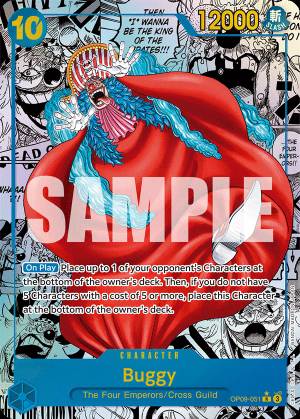
Buggy (OP09-051-v2) | $938.50 | €1.00 | Same pattern |
Mihawk MR (OP01-070-v2) | $899.00 | €2.00 | Same pattern |
Koby (OP11-119-v2) | $899.00 | €1.00 | Same pattern |
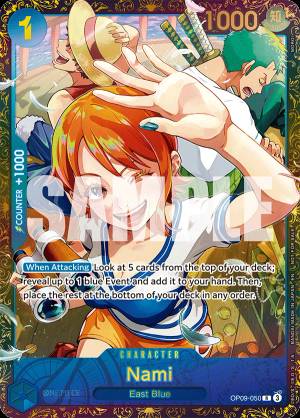
Nami (OP09-050-v2) | $894.09 | €1.00 | Same pattern |
The €1 floor is a parsing artifact, not an arbitrage opportunity. The Haki database surfaces what Cardmarket reports as the market price, but I treat anything below 30% of TCGPlayer as a phantom number unless I can confirm a real listing.
How to spot a phantom EUR price in 30 seconds
Three checks, in order:
- Look at the price ratio. If Cardmarket EUR (in USD-equivalent) is less than 50% of TCGPlayer USD on a card priced over $50, treat it as suspicious.
- Check sold listings, not market price. Cardmarket’s “Article List” view shows you actual current listings. If the cheapest real listing is in line with TCGPlayer, the gap is fake.
- Compare against another high-value card from the same set. If you see a $900+ card from OP09 reporting €1 on CM, scan two or three other OP09 chase cards. If they all show €1, you are looking at a sales-volume gap, not real EU pricing.
Where this matters for actual buying
Most of the chase Yonko/alt-art cluster from OP09 Emperors of the New World genuinely trades at 13–30% lower in EUR than USD when EU listings are real. That cluster is where you should buy on Cardmarket if you can.
The OP01 originals (Romance Dawn Manga Rares, original Leader chase prints) trade close to parity. The DON!! Championship promos and the most heavily-collected EU character cards (Charlotte Linlin, certain Heroines) are cheaper on TCGPlayer.
For a budget collector, the rule of thumb that has held over 12 months of price snapshots:
- Buying alt-art Manga Rares from OP07–OP12? Check Cardmarket first.
- Buying Championship promos or DON!! Gold cards? Check TCGPlayer first.
- Buying anything else? Check both before deciding.
OP09 Manga Rare cluster (Cardmarket usually cheaper)
Shipping and fee math
The other thing buyers underweight: fees and shipping change the gap.
- Cardmarket buyer protection is roughly 5% (varies by seller and total). It is opt-in; without it, you have no recourse if the card arrives damaged. On a $700 card, do not skip it.
- International shipping from EU to US for a single card is €15–25 depending on tracking and insurance.
- TCGPlayer Direct vs marketplace has a 12% seller fee built in, so listed prices already include that — the price you see is the price you pay, plus shipping (~$5–8 domestic).
For the 30% Nami gap above, after shipping and protection, your net savings on a single $878 card is around $200. For a 13% gap on a $966 Shanks, the net savings after fees is around $90 — still worth it, but tighter than the headline.
My personal default
When I’m pricing a card to add to my own collection, I check both columns in the database, then I open the actual listings on whichever marketplace looks cheaper. I will not transact on the headline market price alone. The “live listings vs market price” gap is the part that the headline tables don’t show, and it is where most pricing-tool comparisons fall apart.
FAQ
Is it actually safe to buy a $900 card from Cardmarket if I’m in the US?
Yes, with two caveats. Use Cardmarket buyer protection (5% extra), and pick a seller with 100+ sales and a 99%+ rating. EU sellers ship more carefully than the US average in my experience — but international tracking adds a week.
What’s the cheapest way to convert EUR to USD for paying?
PayPal is the easiest but takes about 4% on the conversion. A multi-currency debit card (Wise, Revolut) typically takes 0.5–1%. On a $700 card, that’s a $25–30 difference. For frequent buyers, the multi-currency card pays for itself.
Why does the Haki app show the lower EUR figure if it’s not the real market price?
Because that is what Cardmarket’s API reports as market price. The app surfaces the data as-is rather than interpreting it. If you want the real number, you have to click through to actual listings — which is exactly what I do when pricing my own buys.
Are the prices in the Haki database delayed?
The TCGPlayer column updates on a 24-hour cycle. The Cardmarket column updates every 48 hours. Both are recent enough to be accurate within 5–10% on chase cards, but I would not transact a $1,000+ purchase without rechecking the source platform first.
Do these gaps apply to Japanese-language cards?
No — this analysis is for English-language One Piece TCG only. Japanese-language cards trade primarily on Yahoo Auctions Japan and Surugaya, with completely different liquidity dynamics.
Related Articles
- One Piece TCG Price Guide 2026: Live Card Values & Market Data
One Piece card values checked August 10, 2026, with market-price ranges, TCGPlayer and Cardmarket caveats, condition adjustments, and exact-print checks.
- All DON!! Cards in One Piece TCG: Complete List & Prices (2026)
Every DON!! printing tracked by Haki, including Gold DONs, foils, event promos, exact codes, and a price snapshot checked August 10, 2026.
- OP14 Azure Sea's Seven: What I'd Buy, What I'd Skip, What I'd Wait On
OP14 dropped in January 2026. Four months later, prices have settled enough to call which cards are worth buying now, which are still falling, and which to wait out. Real prices from the Haki database.

Scan and track every One Piece TCG card.
Identify cards with the Haki TCG scanner, check dated market prices, build decks, and manage your collection.