One Piece TCG Price Guide 2026: Live Card Values & Market Data
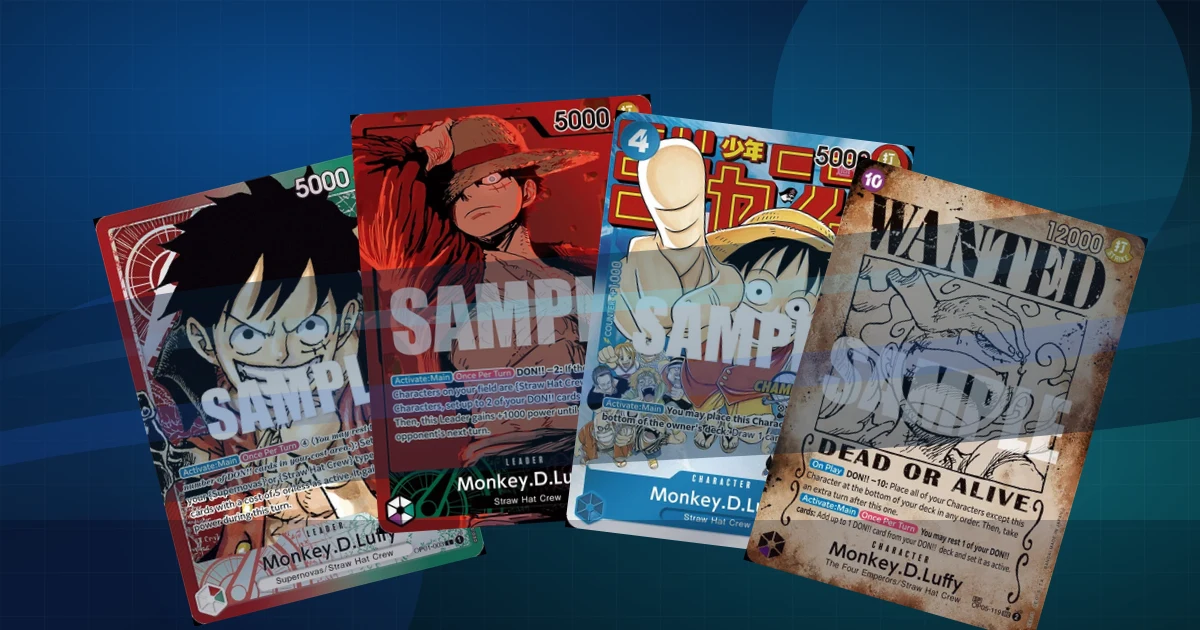
The value of a One Piece card starts with its exact printing, not its character name. A base card, alternate art, promotional version, Manga-style chase, and premium DON!! may look related in search results while trading in completely different markets.
The production export was checked on August 10, 2026. It contained 4,681 records with a tracked TCGPlayer USD field; 4,580 had been updated within the preceding two days. The ranges below use those fresh rows and describe a dataset, not an offer to buy any card.
How much is my One Piece card worth?
Use this five-step process:
- Identify the exact card code, artwork, language, and treatment.
- Open that printing in the card database.
- Check the price source and date.
- Compare recent sold results for the same raw printing and condition.
- Subtract selling fees, shipping, and any condition discount from an expected sale value.
A tracked market field is a starting point. It is not an offer to buy your card and not proof that an active listing will sell.
Current tracked price range
| August 10 distribution | Tracked USD |
|---|---|
| Minimum | $0.02 |
| 25th percentile | $0.11 |
| Median | $0.40 |
| 75th percentile | $8.73 |
| 90th percentile | $57.15 |
| 95th percentile | $149.46 |
| Maximum field | $999.99 |
The shape matters more than the maximum: 2,594 fresh rows were below $1, 593 were $1–$4.99, 659 were $5–$24.99, 423 were $25–$99.99, and 311 were $100 or more. Most catalog records are inexpensive play or collection copies even though chase cards dominate search and social media.
The maximum field is a feed value, not proof that a copy sold for that amount. For the screened high-end list with exact codes and cross-market checks, use the most expensive One Piece cards ranking.
What actually moves prices?
The primary drivers are:
- Competitive demand — Meta leaders and key staples climb quickly.
- Collector demand — Character, artwork, and treatment can matter even when a card sees little play.
- Available supply — Product openings, promotions, and reprints change how many copies reach the market.
- Condition — Whitening, scratches, dents, and print lines change the relevant comparison.
- Liquidity — A price based on sparse trades can be less reliable than a deep market.
- Region and language — English TCGPlayer and European Cardmarket values are separate pools.
TCGPlayer versus Cardmarket
Do not convert EUR to USD and assume the result should match. The platforms have different sellers, buyer populations, fees, shipping costs, and transaction histories. For a thinly traded card, a single sale can move an aggregate value.
Use the Cardmarket vs TCGPlayer guide for a side-by-side workflow.
Condition and grading caveats
Price feeds generally assume a raw market comparison; your copy still needs a condition adjustment. Separate Near Mint, Lightly Played, and damaged comparisons. A graded price requires the same grading company and numeric grade.
Start with the Near Mint vs Lightly Played guide. If grading might make sense, use the grading process guide and ROI calculator.
A repeatable price-check workflow
- Scan or search the card.
- Confirm the exact code and image.
- Record both market value and source date.
- Check a second market or completed-sales source.
- Note condition and language.
- Save the observation so a later comparison uses the same printing.
The Market Values feature explains the in-app workflow, and the price-trends guide shows how to turn dated observations into a 30/90-day record.
Common pricing mistakes
- Pricing an alternate art from a regular card’s sale
- Comparing a graded slab with a raw copy
- Treating an asking price as a completed sale
- Ignoring the date on a market field
- Using a character name without the card code
- Mixing English and Japanese versions
- Ignoring fees and shipping in a “profit” calculation
FAQ
Does Haki buy cards at the displayed price?
No. Haki is an identification and collection tool. A displayed market field is reference data, not a bid or guarantee.
How often should I check value?
Check when making a transaction and use a consistent weekly or monthly cadence for a collection. The important part is recording the source and date.
Why do two cards with the same name have different values?
They may be different sets, variants, artwork, treatments, languages, or conditions. Open the exact-print page for each code.
Related Articles
- Cardmarket vs TCGPlayer: Where to Actually Buy One Piece Cards in 2026
I see both Cardmarket EUR and TCGPlayer USD prices for every card in the Haki database. Here's a 2026 breakdown of where the price gap is real, where it's a trap, and which cards to buy on which marketplace.
- All DON!! Cards in One Piece TCG: Complete List & Prices (2026)
Every DON!! printing tracked by Haki, including Gold DONs, foils, event promos, exact codes, and a price snapshot checked August 10, 2026.
- OP14 Azure Sea's Seven: What I'd Buy, What I'd Skip, What I'd Wait On
OP14 dropped in January 2026. Four months later, prices have settled enough to call which cards are worth buying now, which are still falling, and which to wait out. Real prices from the Haki database.

Scan and track every One Piece TCG card.
Identify cards with the Haki TCG scanner, check dated market prices, build decks, and manage your collection.