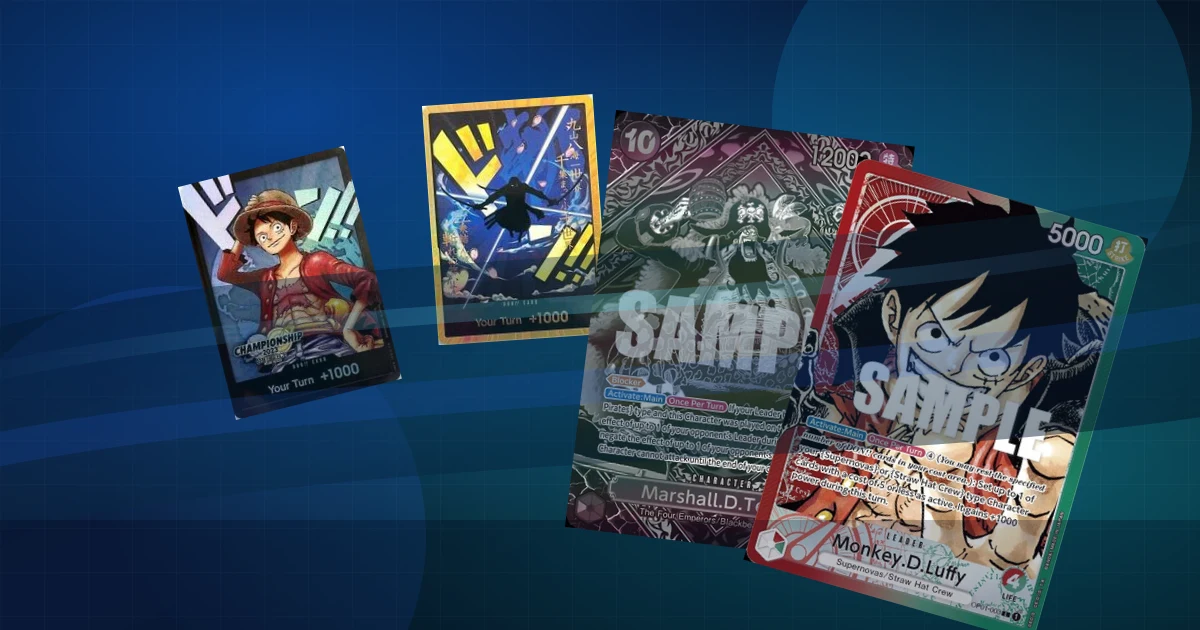
Most Expensive One Piece Cards in 2026: Live Top 10 Prices
This is Haki’s single evergreen ranking for the most expensive One Piece TCG cards. The production export was run on August 10, 2026, then sorted by TCGPlayer USD market price with every variant kept separate. That distinction matters: a regular card, alternate art, Manga Rare, event promo, and premium DON!! can share a character name while having completely different supply and value.
Before ranking, Haki removed records more than two days old, records without both USD and EUR fields, and records where the USD/EUR ratio fell outside 0.2–5. That guard catches obvious stale or mismatched marketplace rows, but it cannot prove a sale. Open the exact card page and marketplace before using any number for a purchase, sale, insurance value, or grading declaration.
The 10 most expensive One Piece TCG cards in 2026
| Rank | Exact printing | Product/source | TCGPlayer | Cardmarket |
|---|---|---|---|---|
| 1 | Sanji OP07-064-v2 | Championship 2024 Top Players Pack | $999.99 | €294.13 |
| 2 | Tashigi OP12-031-v2 | Prize Cards | $999.99 | €446.10 |
| 3 | Charlotte Katakuri OP03-123-v2 | Prize Cards | $990.00 | €655.49 |
| 4 | Sogeking OP03-122-v2 | Pillars of Strength | $960.59 | €711.18 |
| 5 | Shanks OP09-004-v6 | Carrying on His Will | $931.31 | €801.75 |
| 6 | Eustass“Captain”Kid ST10-013-v1 | Championship 2023 Top Players Pack | $899.99 | €328.51 |
| 7 | Uta OP06-001-v2 | Anime 25th Collection | $899.66 | €652.24 |
| 8 | Roronoa Zoro PRB02-006-v2 | The Azure Sea’s Seven | $884.29 | €888.44 |
| 9 | Eustass“Captain”Kid OP05-074-v2 | Awakening of the New Era | $883.73 | €826.30 |
| 10 | Gum-Gum Giant OP09-078-v1 | The Best Vol. 2 | $881.37 | €717.46 |
Every row’s price field was updated on August 10. The ranking comes from the same production card collection that supplies the Haki One Piece card database; the article records the checked snapshot so the methodology stays auditable.
How this ranking works
The primary sort is the numeric TCGPlayer USD market field in Haki’s August 10 export. Cardmarket EUR appears beside it as a cross-market reasonableness check, but EUR and USD are not mixed to decide rank. Records that fail the freshness or cross-market screen are not promoted into the table.
This methodology has limits:
- A market price is an aggregate indicator, not a guaranteed sale price.
- Thinly traded prize cards can move sharply after one transaction.
- A stale or incorrect marketplace match can distort a feed.
- Condition, language, and grading are separate from a raw-card market field.
- A listing price is not the same as a completed sale.
Use the table as a discovery and comparison tool. Verify the exact card and recent market activity before acting.
Why cards reach the top 10
The highest-value printings usually combine several independent sources of demand. No single rarity label guarantees value.
1. Permanently capped supply
Tournament prizes, attendance promos, and limited product cards can have much less supply than a booster-set parallel. Distribution matters more than a dramatic rarity name. Confirm the product source in the card record rather than assuming every promo is scarce.
2. Iconic character + alt-art treatment
Character collectors create demand outside tournament play. A premium artwork of Luffy, Nami, Shanks, Zoro, Boa Hancock, or another popular character can retain interest even when the base gameplay card is inexpensive.
3. Premium treatment and pull difficulty
Manga-style art, special texture, serial or event markings, and other chase treatments separate a premium printing from its play copy. Use the image and full variant code; marketplace labels such as “AA” can be inconsistent.
4. Liquidity and buyer depth
A price based on repeated transactions is more useful than one based on a single unusual sale. Popular sets and characters tend to have more buyers; extremely scarce promos may be valuable but slower to sell.
5. Reprint and substitute risk
Gameplay cards can lose a scarcity premium when a functional or direct reprint expands supply. Premium art may behave differently, but no card is immune to changing collector preference. Read announcements and compare exact product codes before assuming supply is fixed.
Raw price versus graded value
A raw market field does not predict a PSA, BGS, or CGC result. Centering, corners, edges, surface, and print quality determine whether grading adds value. Compare the downside grade as well as the best-case grade, then include fees, shipping, and insurance.
Use the One Piece card condition guide, then follow the step-by-step grading guide or the grading ROI calculator.
Where to check the latest price
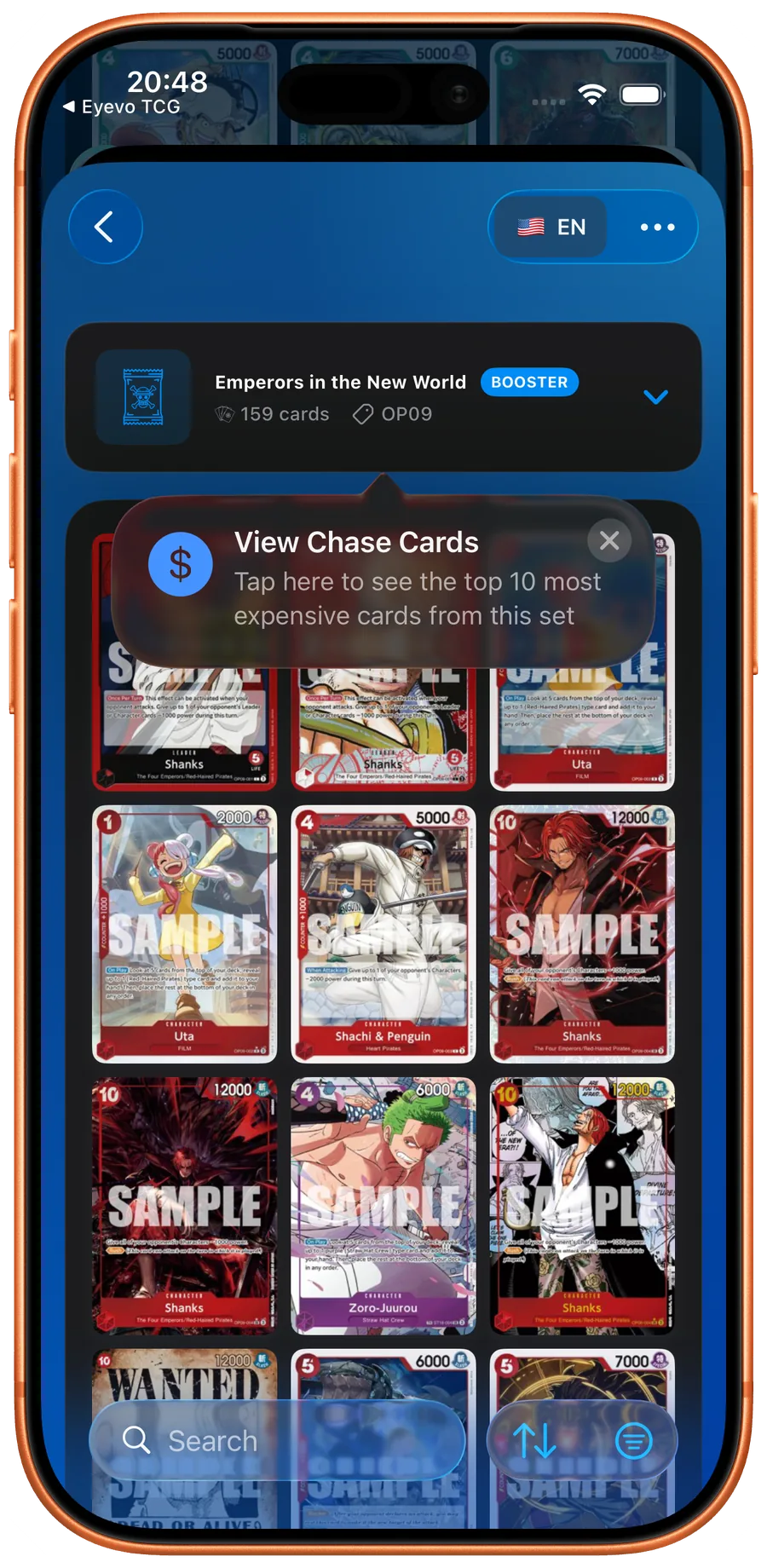
Click a row in the ranking to open that exact printing. The card page shows the price-check date and marketplace link. The scanner feature helps identify a card in hand, while the Cardmarket vs TCGPlayer guide explains why regional values may differ.
How to actually buy any of these
The standard rules apply, plus a few specific to high-value cards:
- Verify the variant code. The card detail pages show exact variant suffixes where the source provides them. Ask for clear front-and-back photos when a listing is ambiguous.
- Compare completed sales. A market field and current listings are inputs, not proof of what your copy will sell for.
- Authenticate expensive cards. Use the fake-card guide and consider a reputable in-person or grading workflow when the value justifies it.
- Budget for illiquidity. A rare card may take time to sell without a steep discount.
Building a tracking list
If you actively collect at this tier, maintain a watchlist of exact card codes rather than names. Record the source, observed price, and date each time you check so you can distinguish real movement from a feed change.
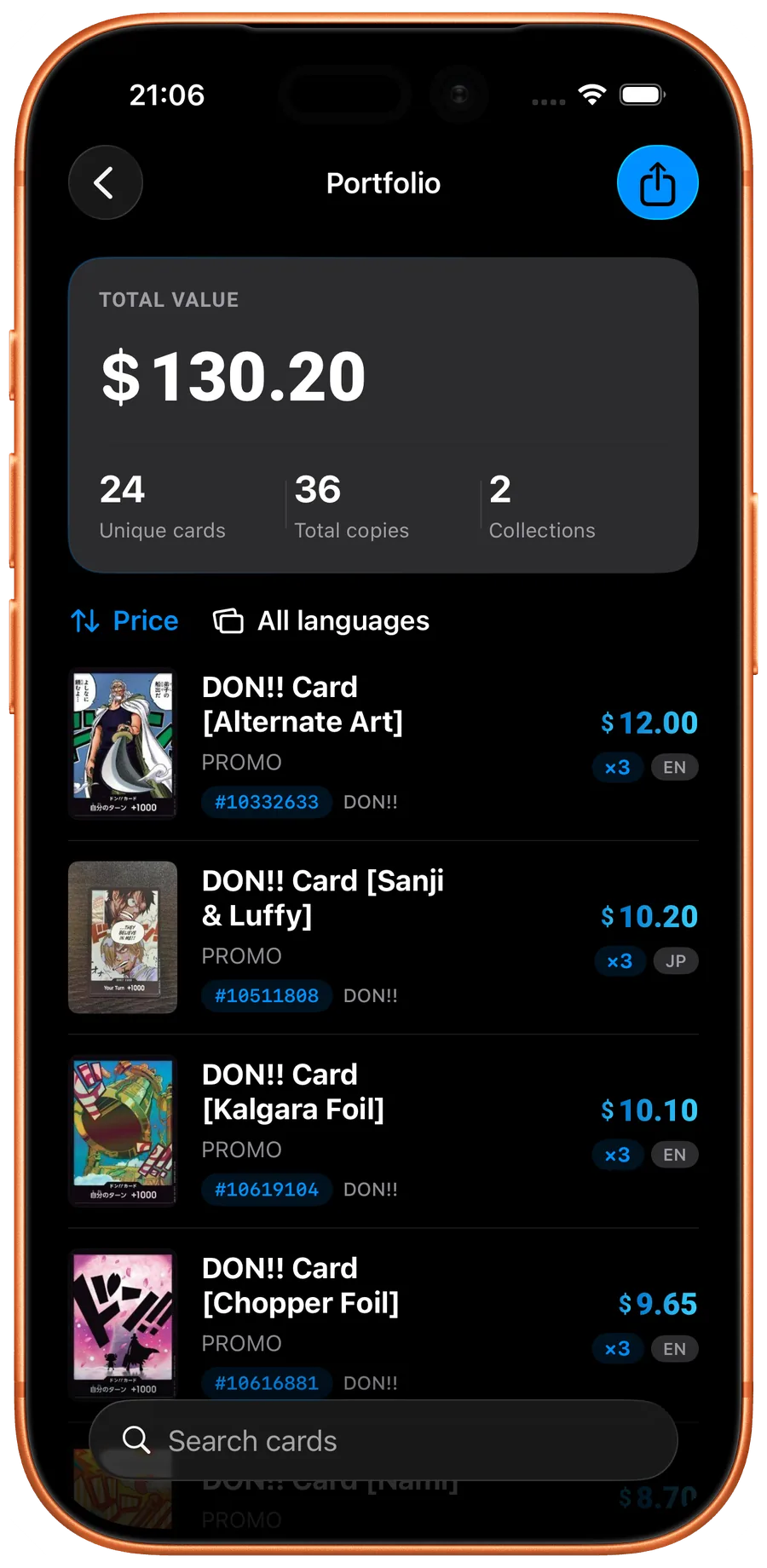
The collection feature keeps identified printings together and makes it easier to review a consistent list.
FAQ
How often does this top-10 list change?
The underlying feed can change whenever its source publishes a new observation. This article’s visible table was checked on August 10, 2026; verify again before transacting.
Are these prices for raw cards or graded copies?
The database market fields describe raw cards. A graded card needs grade-specific sold comparisons; do not apply a universal multiplier.
Can I check current prices without leaving this page?
Click any card name above. Its page shows the tracked value, exact printing, price date, and marketplace link. Treat the source date as part of the number.
Why does Cardmarket sometimes show much lower prices for these cards?
The platforms cover different regions, currencies, sellers, and transaction pools. Low sales volume and conversion timing can widen the gap. The Cardmarket vs TCGPlayer breakdown explains how to compare them.
Which set has the best ROI on chase cards in 2026?
This ranking measures expensive raw printings, not return on investment. ROI also requires purchase price, selling costs, time, and risk, so the table cannot identify a “best ROI” set by itself.
How do I know if a “great deal” listing is actually a fake?
A large discount is a reason to slow down, not proof of a fake. Match the exact printing, inspect seller history and high-resolution images, and use the fake-card guide before paying.
Related Articles
- Boa Hancock Cards in One Piece TCG: Every Print, Every Price
Compare every tracked Boa Hancock printing in the Haki One Piece TCG database, including card codes, sets, rarities, DON variants, exact-print links, and prices.
- Charlotte Pudding Cards in One Piece TCG: Every Print, Every Price
Compare every tracked Charlotte Pudding printing in the Haki One Piece TCG database, including card codes, sets, rarities, exact-print links, and prices.
- How to Grade One Piece Cards: PSA, BGS & CGC Guide (2026)
A step-by-step One Piece card grading guide: inspect condition, choose PSA, BGS, or CGC, declare value, pack safely, submit, and check the result.

Scan and track every One Piece TCG card.
Identify cards with the Haki TCG scanner, check dated market prices, build decks, and manage your collection.