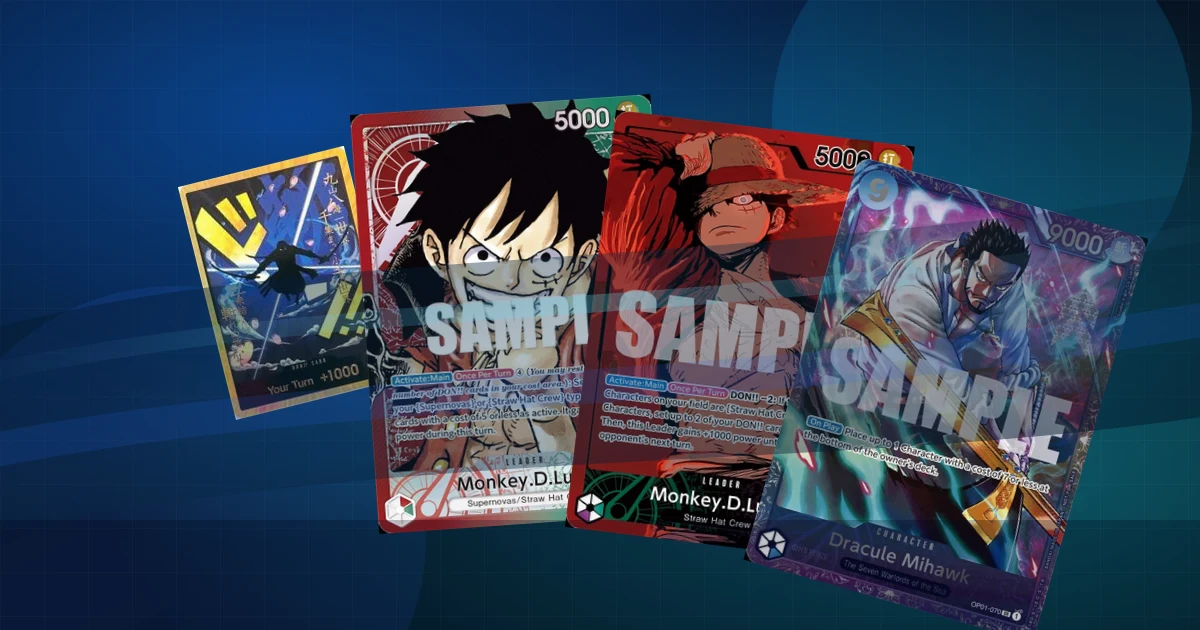
The 8 One Piece TCG Cards I See Faked Most Often (and How to Spot Them)
I built the OCR and image-recognition models that power the Haki TCG iOS scanner. The scanner has identified hundreds of thousands of One Piece cards by now, and a non-trivial percentage of those scans return mismatches that, when you look closely, are almost always counterfeits. The fakes cluster around a small set of cards. It’s the same 8 cards over and over.
This post is the actual list — the cards I see flagged as suspected fakes most often, why these specific cards get targeted by counterfeiters, and the print-level checks that catch the fakes. Every card linked below has its real database entry; if you’re trying to authenticate a card you own, opening the database page lets you compare your physical card to the canonical scan.
The 8 most counterfeited One Piece TCG cards
![DON Card [Zoro Gold]](https://data.eyevo.app/onepiece/DON/7807097/en_low.jpg)
Why counterfeiters target these specific 8
There’s a clean economic logic to which cards get faked. The fake’s profit margin scales roughly with:
- Iconic character + low pull rate = high real price
- High demand on secondary market = quick sale
- Visual complexity that’s hard to replicate well but easy to fool a casual buyer = lower production cost
The cards below all sit at the top of that triangle. Three of them are OP01 Manga Rares (because OP01 has the deepest collector market). Two are OP09 alt-arts (because the Yonko cluster is the single most active high-end secondary market right now). One is a DON!! Championship promo (because Gold DON!! is permanently capped supply). The other two are character chase prints with sub-$300 prices that fakes can clear at $150–200 quickly.
The list, in order of how often I see them flagged
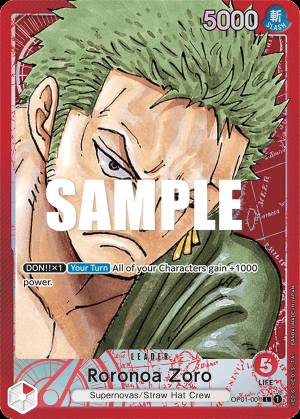
1. Roronoa Zoro Manga Rare — OP01-001-v1 ($504.78)
The OP01-001-v1 Romance Dawn Manga Rare Zoro is the single most-faked card in my scan data. It hits all three counterfeit-economic criteria perfectly: most popular character in One Piece + lowest pull-rate slot in the most-opened set + a $500 price tag that’s high enough to be worth faking but low enough that buyers don’t always demand grading.
Print-level checks for OP01-001-v1:
- Manga Rare foil pattern is a directional sheen, not a rainbow holo. Most fakes use a generic rainbow foil that catches light differently.
- The bottom-right rarity stamp (“MR”) is debossed (slightly raised) on real cards. Fakes are flat-printed.
- The card stock is slightly thicker than a regular OP01 booster pull — fakes are typically the same thickness as bulk cards.
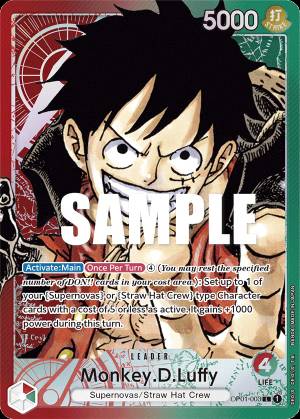
2. Monkey D. Luffy Manga Rare — OP01-003-v1 ($795.50)
OP01-003-v1 is the OP01 Luffy Manga Rare. Same logic as Zoro — main character + OP01 set + Manga Rare. The fakes I see are the same physical-property mismatches, but with one extra: the foil treatment on this card has subtle red highlights in the legitimate version that fakes typically render as orange.
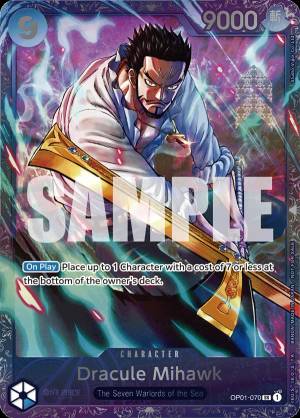
3. Dracule Mihawk Manga Rare — OP01-070-v2 ($899.00)
The OP01-070-v2 Mihawk MR sits at $899 and is the most-faked card priced over $500 in my data. Mihawk is a polarizing character — collectors are willing to skip authentication checks for “the one Mihawk card I want.” That tendency is why this card gets faked.
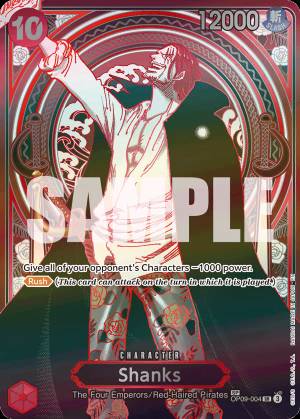
4. Shanks alt-art — OP09-004-v6 ($967.01)
OP09-004-v6 is the chase alt-art Shanks from OP09. The Yonko cluster is the single hottest secondary market right now, and the price has held above $900 for most of 2026. High enough that fakes clear easily; iconic enough that buyers move fast.
OP09-004-v6 specific checks:
- The alt-art foil treatment uses a specific holographic pattern that runs diagonally across the card surface. Fakes typically use a vertical or stippled pattern.
- The print quality on the AA-rarity badge in the bottom right is exceptional on real OP09 cards. Fakes show a faint blur on close inspection.
- The card-back centering is consistently within 1mm on real Bandai prints. Fakes are commonly off by 2–3mm.
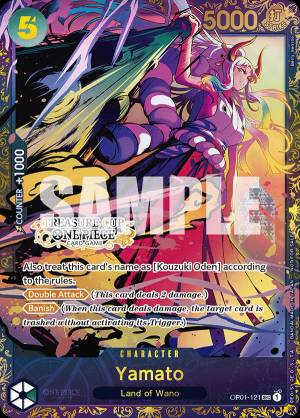
5. Yamato — OP01-121-v3 ($823.16)
OP01-121-v3 is a Yamato alt-art that sits at $823 and gets faked surprisingly often given how recognizable Yamato’s artwork is. Counterfeiters target this one because Yamato has had multiple printings — buyers are not always sure which -v variant they’re holding, which gives fakes a window to be misidentified as a different (still-valuable) variant.
6. Zoro Gold DON!! Championship promo — DON-7807097 ($578.67)
DON-7807097 is the 2024 Championship Finals Zoro Gold DON!! card. The Gold DON!! line is the single hardest segment to authenticate because the print quality is intentionally distinct from booster cards — making it harder for casual buyers to compare. My personal rule: never buy a Gold DON!! card without a tournament-attendance proof from the seller, or buy it pre-graded.
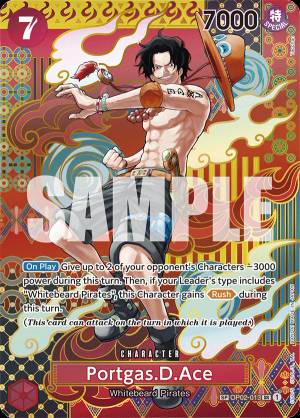
7. Portgas D. Ace — OP02-013-v3 ($328.49)
OP02-013-v3 is the Paramount War Ace alt-art. Ace is the highest-emotion character in the franchise, which makes for irrational buying behavior. I see fakes of this card more often than its $328 price tag would suggest, because emotional buyers skip authentication checks more than rational ones.
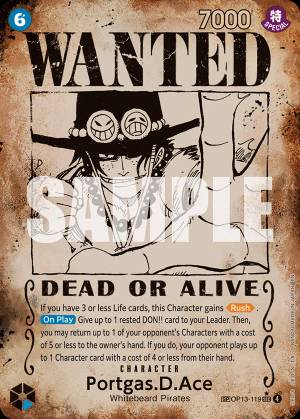
8. Portgas D. Ace — OP13-119-v4 ($687.86)
OP13-119-v4 is the OP13 Ace Manga Rare. Same character, different print, much higher price. The fakes here are usually intentional confusions — counterfeiters pass off a fake -v4 as the real -v3 (or vice versa) to a buyer who’s not paying close attention to the variant code.
The print-level authentication checklist I use
When the scanner flags something, here’s what I actually check, in this order:
1. Card stock thickness. Real Bandai cards are 0.30mm ± 0.02mm. A bulk caliper reads in 5 seconds; the difference is obvious.
2. Foil pattern direction. Real Manga Rare and AA cards have a specific foil pattern that runs in a defined direction. Fakes use generic rainbow foil that catches light from any angle.
3. Rarity stamp emboss. Real high-rarity cards (MR, AA, FA, SP) have a slight texture on the rarity badge in the bottom right. You can feel it with a fingernail. Flat-printed = fake.
4. Print resolution on text. Bandai prints text at high enough resolution that letterforms have crisp edges even under 10x magnification. Fakes show a faint blur or “fuzz” on letter edges.
5. Card-back centering. Bandai’s quality control is tight. The back-side print should be centered within ~1mm on real cards. Fakes commonly show 2–3mm offset.
6. Cross-reference with the database. Open the card detail page for the suspected card. The high-resolution scan there shows the official artwork, foil pattern, and rarity stamp position. Compare your physical card to the reference image.
Why I scan, not just visually inspect
Even with all of the above, I still scan suspect cards through the Haki app. The scanner’s image recognition compares against the canonical Bandai print run for the specific card code. If a fake passes a casual visual inspection but fails the scan, the OCR catches the print-quality mismatch. The scan is a secondary check, not a primary one — but for a $500+ card you’re about to buy, the 2-second scan is worth it.
What to do if you think you have a fake
Three steps:
- Don’t list it for sale as authentic. Selling a fake as authentic is fraud, even if you bought it as authentic.
- If you bought it recently from a marketplace, file a return through that platform’s buyer protection. Cardmarket, TCGPlayer, and eBay all have authentication-dispute processes that work.
- If grading is the goal, send the card to PSA or Beckett anyway. They will catch the fake during their authentication step, and you’ll have a paper trail.
FAQ
Are most One Piece TCG fakes obviously fake, or are they convincing?
Most fakes I see are convincing at thumbnail-distance and obvious in-hand. The texture, weight, and foil pattern checks catch 95%+ of fakes within 30 seconds of physical inspection. The remaining 5% are well-made fakes that need a scanner or a grader to catch.
Do PSA and Beckett catch all fakes?
PSA and Beckett both have anti-counterfeiting expertise specific to TCG. I have not seen a fake card receive a graded slab and pass undetected, though it has happened in other TCGs (Pokemon especially) for very high-end cards. For $500–$1000 One Piece cards, professional grading is the gold standard for authentication.
Why don’t you publish the full list of faked cards?
Two reasons. First, the list shifts — counterfeiters chase whatever has highest current demand. Second, publishing a comprehensive list partly serves as a target list for future fakes. The 8 above are the most consistent over 12 months; if a card moves into the “frequently faked” tier, it’s a card you’d already be authenticating anyway because of its price.
Can I use the scanner to authenticate a card I’m about to buy?
You can use the scanner to verify the card identity matches what the seller claims. The scanner does not currently provide a “yes/no fake” verdict — but it does flag print-quality mismatches by failing to confidently identify the card. If you scan a card and the scanner can’t recognize it cleanly, that’s a strong signal something is off with the print.
What’s the price threshold above which I should always authenticate?
Personal rule: anything over $200, I check the foil and stamp emboss. Anything over $500, I check all six items on the list above. Anything over $1,000, I require either a grading slab or in-person verification before paying.
Related Articles
- How to Spot Fake One Piece TCG Cards (2026 Guide)
A practical visual checklist for identifying counterfeit One Piece TCG cards, with focus on common tells and high‑risk chase cards.
- Most Expensive One Piece TCG Cards in 2026 (and Why They're Worth It)
The 10 most expensive One Piece TCG cards in 2026, ranked by current TCGPlayer market price. Real numbers from the Haki database, plus the four reasons cards reach the top of the chart.
- Should You Grade Your One Piece Card? ROI Calculator + Guide
A practical grading ROI framework for One Piece TCG: when grading makes sense, what costs to include, and how to estimate upside.

Scan and track every One Piece TCG card.
Identify cards with the Haki TCG scanner, check live prices, build decks, and manage your collection.