
How to Grade One Piece Cards: PSA, BGS & CGC Guide (2026)
Grading a One Piece card means sending one exact printing to an independent company for authentication, condition scoring, and encapsulation. The key decision is whether the likely grade and resale premium justify grading fees, shipping, insurance, and the risk that your card scores below expectation.
This guide covers the process from raw card to slab. If you only need the financial decision, use the separate One Piece card grading ROI calculator. If you are still learning condition terms, start with Near Mint vs Lightly Played.
Step 1: identify the exact printing
Do not submit from the artwork alone. One Piece cards can share a name, number, and rules text while using a different parallel treatment, promo stamp, language, or product source.
Use this exact-print checklist before you enter the card on a submission form:
- Full card code, including a variant suffix when the database provides one
- English or Japanese release
- Set or promotional product
- Rarity and parallel treatment
- Foil, texture, stamp, or anniversary marking
Use the One Piece card database to match the image and exact code. A scanner can narrow candidates when the card is in hand, while card search is better when you already know part of the name or code. Confirm the product through the set index. Each printing has its own page, so the market price and submission details do not get mixed with another version.
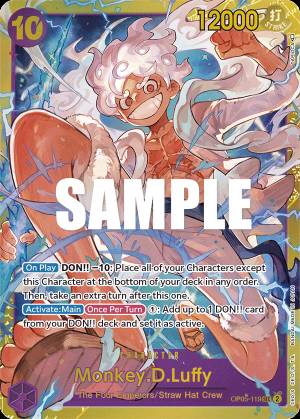
Step 2: inspect the card under consistent light
Use a clean desk, indirect daylight or a neutral desk lamp, and a dark mat. Wash and dry your hands first. Hold the card by its edges and inspect the front and back at several angles.
| Area | What to inspect | Common downgrade |
|---|---|---|
| Centering | Border balance on front and back | Visibly shifted image or narrow border |
| Corners | All four tips under magnification | Whitening, fray, bend, soft corner |
| Edges | Entire perimeter on both sides | Chipping, nicks, rough factory cut |
| Surface | Foil and non-foil areas in raking light | Scratches, dents, print lines, residue |
| Print quality | Ink, registration, texture | Spots, missing ink, factory lines |
Do not clean, press, recolor, trim, or polish a card. Grading companies screen for alteration, and an altered-card result can destroy the economics of the submission. A dry air blower can remove loose dust; anything more aggressive is not worth the risk.
Step 3: estimate a realistic grade range
Use a range, not a single optimistic number. For example: “likely 9, possible 10, downside 8.” Then calculate the outcome at every grade in that range.
PSA publishes its official grading standards, including definitions for each numeric grade and cards it may decline to grade. CGC publishes a separate 10-point grading scale. Standards are company-specific; a “10” is not a promise that another company would assign the same grade.
Step 4: choose PSA, BGS, or CGC
There is no universal best slab. Choose based on the likely buyer, the card, and the service you actually need.
| Company | Best fit to consider | Decision point |
|---|---|---|
| PSA | Broad resale familiarity and population-report comparisons | Compare the likely PSA grade premium with total submission cost |
| BGS | Collectors who care about Beckett’s label/holder and optional grading detail | Confirm the current service and whether subgrades are offered for your tier |
| CGC | TCG-focused collectors and a direct online submission workflow | Check the current tier, declared-value cap, and estimated turnaround |
Service names, prices, value limits, and turnaround estimates change. Check the official PSA Submission Center, Beckett grading page, and CGC services and fees on the day you submit.
Step 5: calculate the all-in cost
Your cost is more than the per-card grading fee:
all-in cost = grading + outbound shipping + return shipping + insurance + supplies + intermediary fee
Compare that number with the difference between the raw value and conservative graded value. Use recent sold listings for the exact code and grade; asking prices are not completed sales. The market-values tools help locate the correct raw printing, but they do not replace grade-specific sold comparisons. If an 8 or 9 produces a loss, only submit when your inspection supports the upside.
Step 6: create the submission accurately
Create an account with the grader, choose the correct card service, and describe every card exactly. Enter the declared value required by that company and choose a service level that accepts it. Keep a copy of the order and photograph the front and back of every raw card before packing.
For PSA, the company says cards, tickets, and packs use its online submission process. CGC says collectors can create an account, complete the online form, and track the submission online. Beckett requires the current Beckett-issued form or online workflow shown on its grading page. Always follow the instructions attached to your exact order; an old video may show obsolete packaging or addresses.
Step 7: sleeve and pack without creating damage
The safe default is a clear penny sleeve inside the grader-approved semi-rigid holder. PSA’s current shipping guide specifically instructs submitters to use clear sleeves and semi-rigid holders and warns against toploaders, tape, pull tabs, and sticky notes for its standard process.
Then:
- Put cards in the same order as the submission form.
- Sandwich the stack between clean cardboard slightly larger than the holders.
- Secure the sandwich without overtightening it.
- Place it inside a sturdy inner box with padding.
- Put the inner box in a tracked outer shipment.
- Use insurance appropriate to the raw declared value.
Do not write a grading prediction on the holder. Do not use adhesive where it can contact a card. Do not reuse a crushed mailer for a high-value submission.
Step 8: receive and verify the slab
When the return arrives, record the opening on video if the value warrants it. Match the label to the card’s name, code, language, and variant. Check the certification number on the grader’s verification page and inspect the holder for damage.
Update the exact printing in your collection tracker with:
- Grading company and numeric grade
- Certification number
- Total grading cost
- Submission and return dates
- New insured value based on relevant sold comparisons
PSA vs BGS vs CGC: the practical answer
Choose the company whose slab your likely buyer recognizes and whose conservative grade outcome still makes financial sense. For a personal collection, holder design and consistency may matter more than maximum resale. For a sale, search completed transactions for the exact One Piece printing in comparable slabs before deciding.
The logo on the label cannot rescue a poor submission candidate. Exact-print identification, honest condition screening, safe packaging, and conservative math are the parts you control.
FAQ
Should I submit a card that is pack fresh?
Pack fresh describes where a card came from, not its condition. Factory centering, print lines, edge chipping, and surface dents can exist immediately out of a pack.
What if my card comes back lower than expected?
Recheck the grader’s standards and the card under strong light. Do not crack and resubmit automatically: include new fees, shipping, possible damage, and the chance of the same or a lower result in the decision.
Where do I decide whether grading is profitable?
Use the grading ROI guide and calculator after you identify the exact printing and estimate a realistic grade range.
Related Articles
- One Piece Card Condition Guide: Near Mint vs Lightly Played
Compare Near Mint, Lightly Played, Moderately Played, and damaged One Piece cards with a repeatable corner, edge, surface, centering, and back checklist.
- Should You Grade Your One Piece Card? ROI Calculator + Guide
A practical grading ROI framework for One Piece TCG: when grading makes sense, what costs to include, and how to estimate upside.
- How to Spot Fake One Piece TCG Cards (2026 Guide)
A safe counterfeit-screening checklist for One Piece TCG cards: exact-print matching, seller evidence, text, color, cut, foil, card back, slabs, and next steps.

Scan and track every One Piece TCG card.
Identify cards with the Haki TCG scanner, check dated market prices, build decks, and manage your collection.