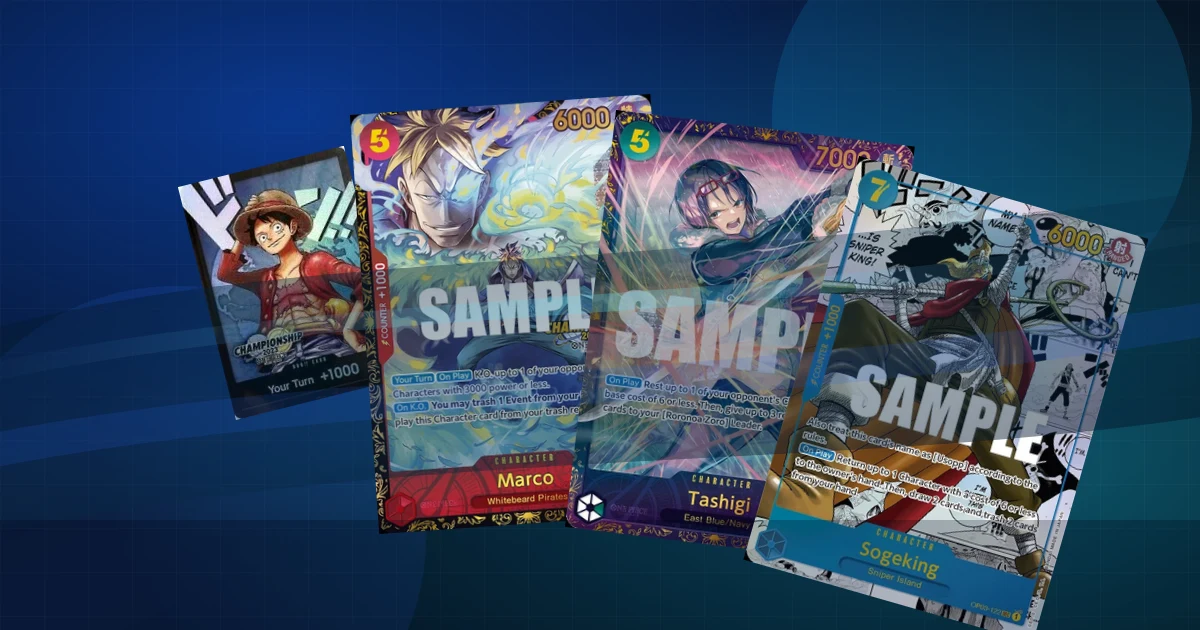
How to Play One Piece TCG: 2026 Rules, Turns, Combat & Counters
This is a practical rules guide. Read it once, then open Sets and Cards in another tab so you can learn while seeing real cards.
The One Piece Card Game is a tempo and resource game: you build pressure with Characters, protect your Leader with counters and blockers, and convert advantage into one final hit.
This explanation follows Bandai’s official play guide and links to the publisher’s current rules, comprehensive rules, tournament manual, restrictions, and errata. Check that official rules page before a sanctioned event because formats and restricted cards can change.
If you are new, focus on three things first:
- Understand the win condition.
- Learn the turn order.
- Spend DON!! efficiently every turn.
1) Win condition in one minute
You win in either of two ways:
- Win a battle against the opponent’s Leader while they have 0 Life cards remaining.
- Leave the opponent with no cards in their main deck.
The normal damage route is:
- Attack their Leader.
- If damage goes through, they take one Life card into hand.
- Repeat until their Life is 0.
- Land one more successful hit to win the game.
2) Deck setup and legal deck structure
A standard deck uses:
- 1 Leader card
- 50 main deck cards
- 10 DON!! cards
Key deck rules:
- You can include cards only in your Leader’s color identity.
- You can include up to 4 copies of the same card number in the main deck.
At the start of the game, shuffle, decide who goes first, and draw five cards. Each player may take one mulligan: return the whole opening hand, reshuffle it into the deck, and draw five new cards. Then place Life cards face-down according to the Leader’s Life value.
3) Turn structure (what happens each turn)
Every turn follows the same rhythm:
| Phase | What you do | Why it matters |
|---|---|---|
| Refresh | Return attached DON!! to the cost area and set rested cards active | Re-opens effects, blockers, and DON!! use |
| Draw | Draw 1 card (first player skips draw on turn 1) | Keeps options flowing |
| DON!! | Add 2 DON!! from the DON!! deck; the first player adds only 1 on turn 1 | Your core resource ramp |
| Main | Play cards, use effects, attach DON!!, and battle in any legal order | Build board and pressure |
| End | Resolve end-of-turn effects, then pass the turn | Completes the five-phase turn |
Battle is not a separate phase. It is one action you can take during the Main Phase, alongside playing cards, activating effects, and giving DON!!.
DON!! rule that changes everything
Each attached DON!! adds +1000 power for the turn. Strong players plan attacks around this math before declaring attacks.
What “Main” and “Activate: Main” mean
During your Main Phase, you may activate an Event marked [Main] from hand after paying its cost. Effects marked [Activate: Main] can also be used during your Main Phase when you pay every stated cost and meet every condition. [Once Per Turn] limits that effect to one activation during the turn.
Unless card text says otherwise, these are not counter-step effects. Follow the timing label printed on the card and use the official errata text if Bandai has corrected the printing.
4) Battle flow: attack, counter, damage
When you attack:
- Choose an active attacker (Leader or Character).
- Rest it and choose the opponent’s Leader or a valid rested Character as the target.
- Resolve attack-triggered effects.
- The defending player may activate one eligible Blocker.
- The defending player may use counter power and
[Counter]Events in the counter step. - Compare power. The attack succeeds when attacker power is at least defender power.
- On successful Leader damage, the opponent checks the top Life card and adds it to hand unless its Trigger is activated according to the card text.
Defense tools to remember:
- Counter power from hand during battle.
- Blocker effects to redirect attacks.
- Trigger text on some cards when taken from Life.
Characters normally cannot attack on the turn they are played, and neither player can attack on their own first turn. A card effect can create an exception only when its text says so.
5) Constructed formats and legal cards in 2026
Beginning April 1, 2026, official play uses Bandai’s block-number system with Standard Regulation and Extra Regulation. For the April 2026–March 2027 Standard window, Bandai’s published overview permits block numbers 2 through 5, with stated exceptions and updates for certain card numbers and Super Parallel Rares.
Format legality is more than color identity and the four-copy rule. Before an event, verify:
- The regulation named by the organizer
- Current block-number eligibility
- The banned/restricted list
- Errata that replace text printed on older copies
- Language rules for the event region
The deck builder helps organize a list, but the official event documents are the authority for legality.
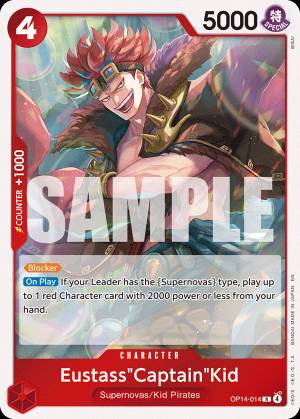
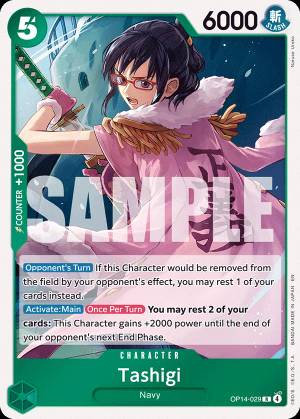
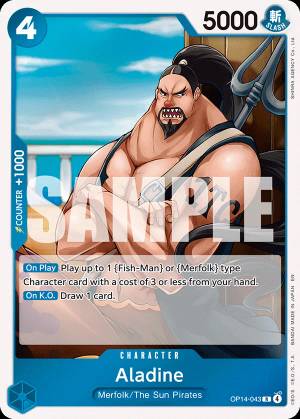
6) Card roles at a glance
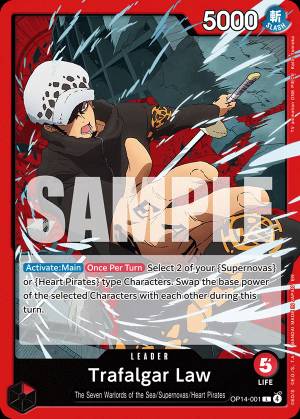
- Leader: Your core unit; determines life and color identity.
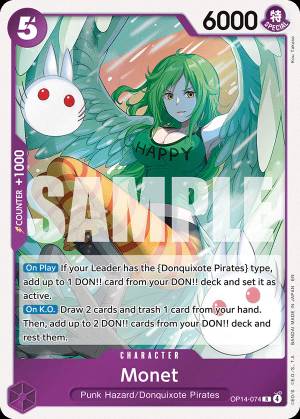
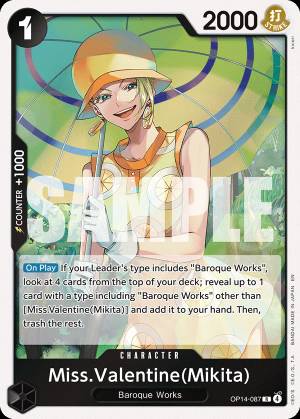
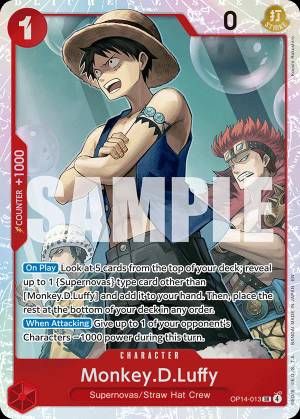
- Character: Main board presence for attacks and pressure.
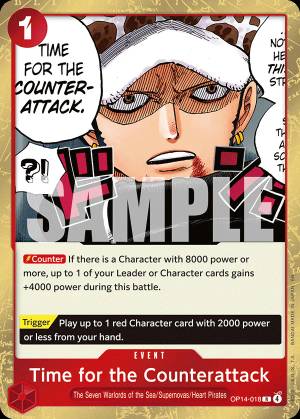
- Event: One-shot tactical effects.
- Stage: Ongoing support effects.
- DON!!: Resource engine and temporary power boosts.
7) Beginner mistakes (and quick fixes)
Mistake: spending DON!! without a plan
Fix: decide your attack sequence before committing DON!!.
Mistake: attacking in the wrong order
Fix: attack with lower-value pieces first to force counters, then push with your strongest line.
Mistake: overcommitting into open counters
Fix: track opponent hand size and leave room for defense.
Mistake: building decks with too many high-cost cards
Fix: keep early plays consistent so your first 3 turns are stable.
8) Fast learning loop with Haki TCG
Use this loop to improve quickly:
- Read one rule section.
- Open matching cards in Cards.
- Check set context in Sets.
- Save cards you test into your collection flow.
- Repeat after each match.
The fastest improvement comes from combining rules knowledge and real card browsing in the same session.
Quick start checklist
- Pick one Leader and one set to focus on first.
- Memorize turn flow before learning advanced combos.
- Track DON!! usage each turn to avoid tempo loss.
- Practice attack order and counter math every game.
Related Articles
- Every Trafalgar Law Card in One Piece TCG, Ranked by Chase Value
Trafalgar Law has 30+ printings across One Piece TCG. Here's the value ladder from $76 to $850, with every print linked, sorted, and explained — pulled live from the Haki database.
- OP02 Paramount War Set Guide: Every Chase, Every Price
Paramount War (OP02) released March 2023. Real prices, real codes, and what the cluster looks like in May 2026 — pulled live from the Haki database.
- OP03 Pillars of Strength Set Guide: Every Chase, Every Price
Pillars of Strength (OP03) released June 2023. Real prices, real codes, and what the cluster looks like in May 2026 — pulled live from the Haki database.
Scan and track every One Piece TCG card.
Identify cards with the Haki TCG scanner, check dated market prices, build decks, and manage your collection.