OP05 Awakening of the New Era Set Guide: Every Chase, Every Price
Awakening of the New Era (OP05) — set context: released December 2023, themed around Purple-color Leaders and the DON!! mechanic expansion. Awakening of the New Era introduced the DON!! mechanic on a wider range of Leaders and pushed the meta toward aggressive midrange. Prices skew toward the SR Awakening leaders and a small group of Manga Rares.
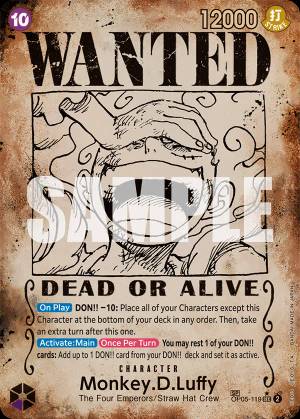
Awakening of the New Era (OP05) is one of the deeper chase clusters in English One Piece TCG. 234 cards from the set currently trade above $0 on TCGPlayer; 20 of them sit above $100. The top card today is Monkey.D.Luffy (OP05-119-v3)** at $729.27**.
This is the actual price ladder pulled from the Haki database on 2026-05-10. Every card linked goes to its database entry with the most current TCGPlayer USD market price.
OP05 chase tier · top 6 by price
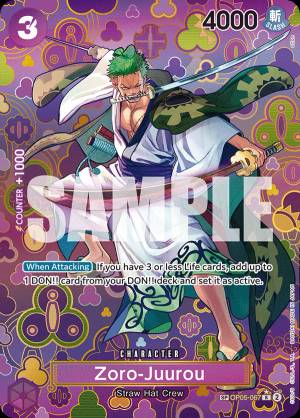

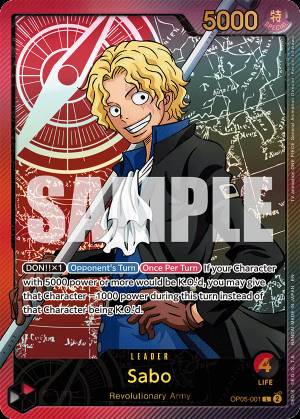
The chase tier
The top 5 character/event cards in OP05, by current price:
| Card | Code | Rarity | Price |
|---|---|---|---|
| Monkey.D.Luffy | OP05-119-v3 | AA | $729.27 |
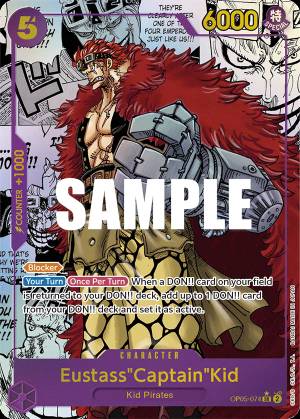
| Eustass”Captain”Kid | OP05-074-v2 | AA | $620.75 |
| Zoro-Juurou | OP05-067-v3 | AA | $520.21 |
| When You’re at Sea You Fight against Pirates!! | OP05-076-v2 | C | $519.48 |
| Monkey.D.Luffy | OP05-119-v1 | AA | $282.55 |
Monkey.D.Luffy at $729.27 is the marquee non-Leader pull from this set.
The Leader cluster
OP05 shipped with 8 Leader cards in active circulation:
| Leader | Code | Colors | AA price |
|---|---|---|---|
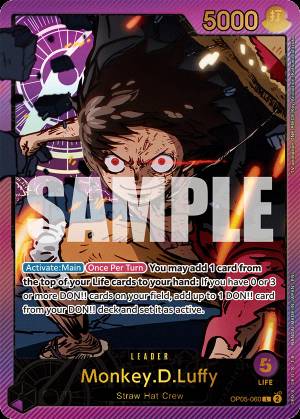
| Monkey.D.Luffy | OP05-060-v5 | Purple | $649.25 |
| Sabo | OP05-001-v2 | Red / Black | $334.94 |
| Enel | OP05-098-v3 | Yellow | $275.75 |
| Belo Betty | OP05-002-v2 | Red / Yellow | $266.82 |
| Monkey.D.Luffy | OP05-060-v2 | Purple | $243.50 |
| Donquixote Rosinante | OP05-022-v2 | Green / Blue | $228.40 |
The most-collected Leader from OP05 is Monkey.D.Luffy at $649.25. Base-rarity (L) versions of every Leader trade between $0.50 and $5 — those are the play copies. The AA-rarity (-v1) prints in the table above are the chase versions for sleeve-and-display.
What I’d buy from OP05 today
Pragmatic picks for May 2026, given current prices and how the set has aged:
- Monkey.D.Luffy (
OP05-119-v3) at $729.27 - Monkey.D.Luffy (
OP05-060-v5) at $649.25 - Eustass”Captain”Kid (
OP05-074-v2) at $620.75
Three cards from the chase tier give you the cleanest exposure to this set without overcommitting to a single piece.
How OP05 compares to the major clusters
| Set | Top card | Top price | Cards above $100 |
|---|---|---|---|
| OP01 Romance Dawn | Mihawk MR | $899 | 11 |
| OP09 Emperors of the New World | Shanks AA | $967 | 9 |
| OP05 Awakening of the New Era | Monkey.D.Luffy | $729.27 | 20 |
OP05 is among the deeper chase clusters in the game.
For broader market context across all sets, see the 10 most expensive One Piece cards in 2026.
FAQ
When does OP05 reprint?
Bandai’s English-language reprint cadence is 12–18 months after initial release. OP05 dropped December 2023, so reprint risk on chase prints is low; the set is past its typical reprint window.
Should I crack OP05 sealed product or buy singles?
Singles. Cracking has a flat expected value (you average out close to box cost in singles). If you specifically want the chase pull experience, buy one box; for everything else, the secondary market is more efficient.
What’s the most undervalued OP05 card right now?
Eustass”Captain”Kid at $84.39. Mid-tier prints often track the chase tier upward when the set ages, and this one has clean character demand.
Are OP05 cards being reprinted in alt-art form in newer sets?
Newer Booster sets often include alt-art prints of characters first introduced in earlier sets. For OP05, watch for the chase character alt-arts in the next 2-3 set releases — these typically trade at 30–50% below the original OP05 chase prices.
How do I track OP05 prices over time?
The iOS app’s collection feature supports per-card price alerts. The full OP05 set page shows current prices for every card, sortable by color, rarity, and cost.
Can I scan OP05 cards with the Haki app?
Yes — the Haki TCG iOS scanner recognizes every OP05 print, including AA-rarity variant disambiguation (-v1, -v2, etc.). The scanner identifies cards in under one second and shows current TCGPlayer pricing immediately after the scan.
Related Articles
- OP02 Paramount War Set Guide: Every Chase, Every Price
Paramount War (OP02) released March 2023. Real prices, real codes, and what the cluster looks like in May 2026 — pulled live from the Haki database.
- OP03 Pillars of Strength Set Guide: Every Chase, Every Price
Pillars of Strength (OP03) released June 2023. Real prices, real codes, and what the cluster looks like in May 2026 — pulled live from the Haki database.
- OP04 Kingdoms of Intrigue Set Guide: Every Chase, Every Price
Kingdoms of Intrigue (OP04) released September 2023. Real prices, real codes, and what the cluster looks like in May 2026 — pulled live from the Haki database.

Scan and track every One Piece TCG card.
Identify cards with the Haki TCG scanner, check live prices, build decks, and manage your collection.