Charlotte Pudding Cards in One Piece TCG: Printings and Tracked Prices

The Haki database separates Charlotte Pudding gameplay cards, Leaders, parallels, alternate arts, and promotional versions into exact-print records. The important collector rule is simple: the name “Charlotte Pudding” does not identify a price. The card code and exact artwork do.
Use the table to compare premium printings and regular play copies. Open a row to check its exact image, set, rarity, effect, and marketplace link. Read the caption for the number of matches and the source date.
| Card | Code | Set | Rarity | TCGplayer (USD) | PriceCharting (USD) | Cardmarket (EUR) |
|---|---|---|---|---|---|---|
 Charlotte Pudding | OP08-058-v2 | Anime 25th Collection | L | $1,199.01Observed | — | €1,135.16Observed |
 Charlotte Pudding | OP03-112-v3 | Prize Cards | AA | $561.87Observed | — | €652.09Observed |
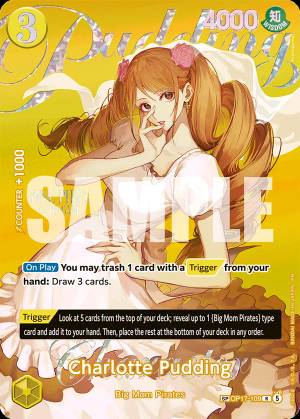 Charlotte Pudding | OP17-109-v1 | One Piece Heroines Edition vol.2 | SP | $287.43Observed | — | €201.61Observed |
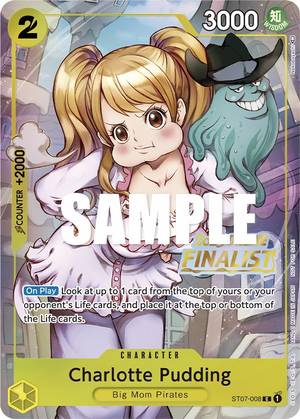 Charlotte Pudding | ST07-008-v2 | Prize Cards | C | $218.46Observed | — | — |
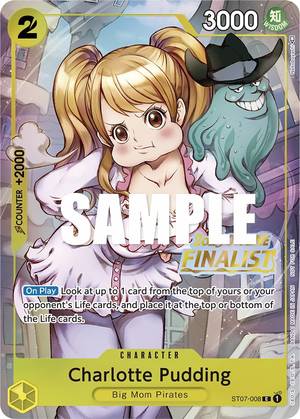 Charlotte Pudding | ST07-008-v4 | Prize Cards | C | $125.39Observed | — | — |
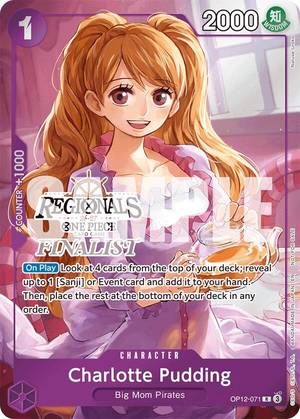 Charlotte Pudding | OP12-071-v2 | Prize Cards | R | $115.58Observed | — | — |
 DON!! Card [Charlotte Pudding Gold] | DON-10856339 | DON!! | PROMO | $97.61Observed | — | — |
 Charlotte Pudding | OP03-112-v2 | Pillars of Strength | SP | $84.43Observed | — | €77.86Observed |
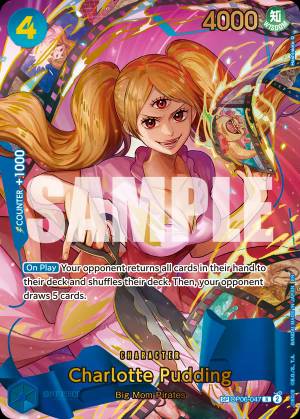 Charlotte Pudding | OP06-047-v4 | Wings of the Captain | SP | $83.03Observed | — | €55.37Observed |
 Charlotte Pudding | OP06-047-v3 | CS 25–26 Celebration Pack | R | $76.57Observed | — | €78.68Observed |
 Charlotte Pudding | OP03-112-v6 | CS 25–26 Celebration Pack | R | $73.21Observed | — | €100.99Observed |
 Charlotte Pudding | OP08-067-v3 | Prize Cards | AA | $65.03Observed | — | €65.89Observed |
 Charlotte Pudding | OP08-058-v1 | Two Legends | AA | $64.94Observed | — | €34.87Observed |
 Charlotte Pudding | ST12-012-v1 | Royal Blood | SP | $49.22Observed | — | €35.53Observed |
 Charlotte Pudding | ST07-008-v1 | Regional Participation Pack Vol.1 | C | $35.54Observed | — | €54.88Observed |
 Charlotte Pudding | OP12-071-v1 | Regional Participation Pack 2026 Vol.1 | AA | $29.28Observed | — | €14.85Observed |
 Charlotte Pudding | PRB02-010-v1 | One Piece Card The Best vol.2 | AA | $19.81Observed | — | €10.17Observed |
 Charlotte Pudding | OP03-112-v1 | Pillars of Strength | AA | $12.70Observed | — | €8.54Observed |
 Charlotte Pudding | OP11-070-v1 | A Fist of Divine Speed | AA | $11.06Observed | — | €6.76Observed |
 Charlotte Pudding | OP12-071-v4 | Misc. Promos | R | $9.25Observed | — | — |
 Charlotte Pudding | OP06-047-v2 | Tournament Pack 2025 Vol.1 | FA | $7.24Observed | — | €4.55Observed |
 Charlotte Pudding | OP03-112-v5 | Tournament Pack 2024 Oct.-Dec. | FA | $5.75Observed | — | €5.48Observed |
 Charlotte Pudding | OP08-067-v1 | Two Legends | AA | $5.45Observed | — | €4.55Observed |
 Charlotte Pudding | PRB02-010 | One Piece Card The Best vol.2 | SR | $5.07Observed | — | €3.13Observed |
 DON!! Card [Charlotte Pudding] | DON-10856340 | DON!! | PROMO | $4.61Observed | — | — |
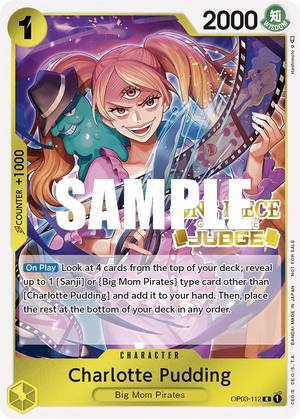 Charlotte Pudding | OP03-112-v7 | Misc. Promos | R | $3.66Observed | — | — |
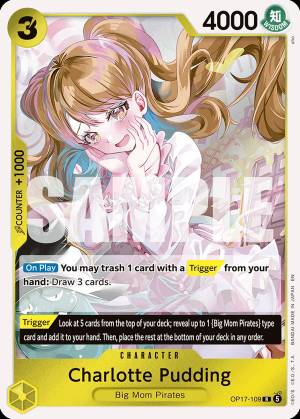 Charlotte Pudding | OP17-109 | The World's Strongest Warriors | R | $1.98Observed | — | €1.14Observed |
 Charlotte Pudding | OP11-070 | A Fist of Divine Speed | SR | $1.37Observed | — | €1.55Observed |
 Charlotte Pudding | OP12-071 | Legacy of the Master | R | $0.54Observed | — | €0.93Observed |
 Charlotte Pudding | OP06-047-v1 | Tournament Pack 2025 Vol.1 | R | $0.39Observed | — | €0.25Observed |
 Charlotte Pudding | OP03-112-v4 | Tournament Pack 2024 Oct.-Dec. | R | $0.36Observed | — | €0.19Observed |
 Charlotte Pudding | OP06-047 | Wings of the Captain | R | $0.33Observed | — | €0.38Observed |
 Charlotte Pudding | ST20-004 | YELLOW Charlotte Katakuri | C | $0.28Observed | — | €0.23Observed |
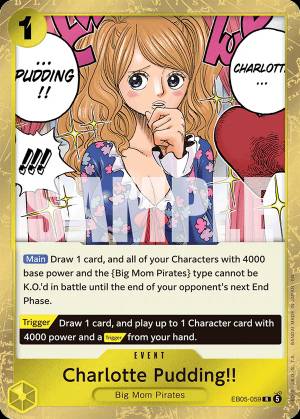 Charlotte Pudding!! | EB05-059 | One Piece Heroines Edition vol.2 | R | $0.26Observed | — | €0.10Observed |
 Charlotte Pudding | OP08-067 | Two Legends | R | $0.26Observed | — | €0.09Observed |
 Charlotte Pudding | ST12-012 | Zoro & Sanji | C | $0.26Observed | — | €0.15Observed |
 Charlotte Pudding | OP03-112 | Pillars of Strength | R | $0.21Observed | — | €0.10Observed |
 Charlotte Pudding | EB03-035 | One Piece Heroines Edition | R | $0.19Observed | — | €0.19Observed |
 Charlotte Pudding | ST07-008 | Big Mom Pirates | C | $0.18Observed | — | €0.10Observed |
 Charlotte Pudding | OP08-058 | Two Legends | L | $0.16Observed | — | €0.09Observed |
 Charlotte Pudding | OP09-087 | Emperors in the New World | C | $0.16Observed | — | €0.08Observed |
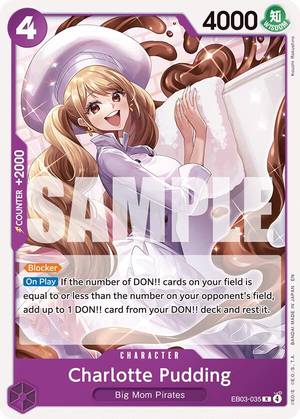 Charlotte Pudding | EB03-035-v1 | PURPLE Charlotte Katakuri | R | $0.15Observed | — | — |
 Charlotte Pudding | EB04-034 | Egghead Crisis | C | $0.11Observed | — | €0.03Observed |
 DON!! Card [Charlotte Pudding Gold] | DON-10619120 | DON!! | PROMO | — | $36.61Observed | — |
 DON!! Card [Charlotte Pudding] | DON-10619118 | DON!! | PROMO | — | $4.42Observed | — |
 DON!! Card [Charlotte Pudding Foil] | DON-10619119 | DON!! | PROMO | — | $3.55Observed | — |
 Charlotte Pudding | OP08-067-v2 | Prize Cards | AA | — | — | €722.87Observed |
How to identify a Charlotte Pudding alternate art
Start with the printed card number, then compare the artwork and finish. Two Pudding cards can share a character name while belonging to different sets or having different gameplay text. Even when the base number matches, a parallel printing can carry a much higher collector premium.
Check these fields in order:
- Full card code and variant suffix
- Set or promotional product
- Leader, Character, or other card type
- Rarity shown in the database
- Artwork, foil, texture, and any stamp
Searching only “Pudding AA” is useful for discovery but too broad for a sale or trade. Open the exact-print page before comparing prices.
If the card is physically in front of you, start with the scanner to produce a candidate match, then confirm the printed code against the result. If you are researching before a purchase, use card search with “Charlotte Pudding,” then narrow by set and inspect the artwork. Both workflows should end on the same exact-print page. A visual match without a code check is not enough when base and premium treatments sit close together in search results.
Why Charlotte Pudding prices vary so much
The price ladder combines different kinds of demand. Competitive players may need a specific card effect, Leader collectors chase parallel Leaders, and character collectors may want one copy of every artwork. Scarce promotional distribution and premium treatments add another layer.
That creates three practical tiers:
- Play copies: lower-cost regular printings bought for decks
- Display parallels: alternate-art or premium-finish cards with a collector premium
- Top chase prints: the scarcest Pudding artwork or treatment in the tracked catalog
A high price on one Pudding record does not make every card with that name valuable. Match the exact printing first.
How to compare Charlotte Pudding prices correctly
Start from the card page, not from a character-level search result. The linked record identifies the set, code, rarity, image, and available marketplace fields together. That prevents three common comparison errors: pricing a regular copy against an alternate art, mixing English and Japanese product records, or treating a seller’s shorthand as an official variant name.
The table keeps TCGplayer USD, PriceCharting USD and Cardmarket EUR references separate. Haki’s market-values tools explain marketplace comparisons. Do not convert one currency and assume the result should equal the other marketplace. Seller depth, region, condition, and the time of the last observation can differ. Use the displayed date as part of the number, and open the marketplace before making a transaction.
Condition belongs in the comparison too. A clean-looking scan confirms identity, not surface quality. Inspect edges, corners, centering, and foil surfaces under angled light. For a high-value candidate, the grading process guide explains how to document the card and estimate a realistic grade range before paying submission fees.
Building a Charlotte Pudding collection
For a character binder, use card code rather than artwork as the checklist key. Keep English and Japanese versions separate if you collect both, and decide whether a reprint with the same gameplay text counts as a separate slot. The collection tracker can store the exact records you own so a base print is not accidentally logged as its premium counterpart.
A practical collection checklist is:
- Complete the inexpensive regular cards first.
- Add distinct Leader and alternate-art treatments by exact code.
- Separate English, Japanese, and promotional product records when they differ.
- Record condition and acquisition cost for premium printings.
- Recheck the source date and marketplace before buying a chase card.
The One Piece card database is the transactional lookup tool; this page is the all-print overview. Browse all One Piece sets when you need product context. For the specific OP08 group, open the Two Legends card list and prices, where the checklist and chase-card routes keep that set’s printings together.
When a new Pudding printing appears
Treat a new catalog row as a separate identification task rather than assuming it replaces an older card. Confirm its product, code, image, and treatment, then decide whether it creates a new slot in your collection. Reprints can share gameplay text while remaining distinct collectibles; conversely, marketplace titles sometimes make one printing look like several different products.
This guide deliberately avoids a fixed “best Pudding card” recommendation. The useful answer depends on whether you need a play copy, a particular artwork, a complete character binder, or a grade candidate. The dynamic table provides the inventory and dated price evidence; your collecting goal determines which row matters.
FAQ
How many Charlotte Pudding cards are in the database?
The table caption shows the current matched-printing count, the number with a tracked market field, and the source date from the available Haki catalog. Refer to that caption rather than a fixed count because new products can add printings.
What does Pudding AA mean?
Collectors usually use “AA” for an alternate-art printing. Confirm the full code, image, set, and finish because marketplace naming is not always consistent.
Which Charlotte Pudding card is most expensive?
Compare exact printings within the same source column. Rows are grouped by provider rather than ranked across different sources and currencies. Verify recent sales of the matching printing and condition before transacting.
Related articles

Boa Hancock Cards in One Piece TCG: Printings and Tracked Prices
Compare every tracked Boa Hancock printing in the Haki One Piece TCG database, including card codes, sets, rarities, DON variants, exact-print links, and prices.
Most Expensive One Piece Cards: August 2026 Price Snapshot
The top 10 tracked One Piece TCG card prices checked August 10, 2026, ranked by exact printing with TCGPlayer and Cardmarket sanity checks.

How to Grade One Piece Cards: PSA, BGS & CGC Guide (2026)
Understand One Piece card grading, condition records, current service availability, submission costs and certification checks.
Haki TCG
Scan and organize your One Piece cards
Check the printing, review available TCGplayer and Cardmarket prices, and save cards to your collection in Haki.
- Card scanner
- Price references
- Collections and decks